
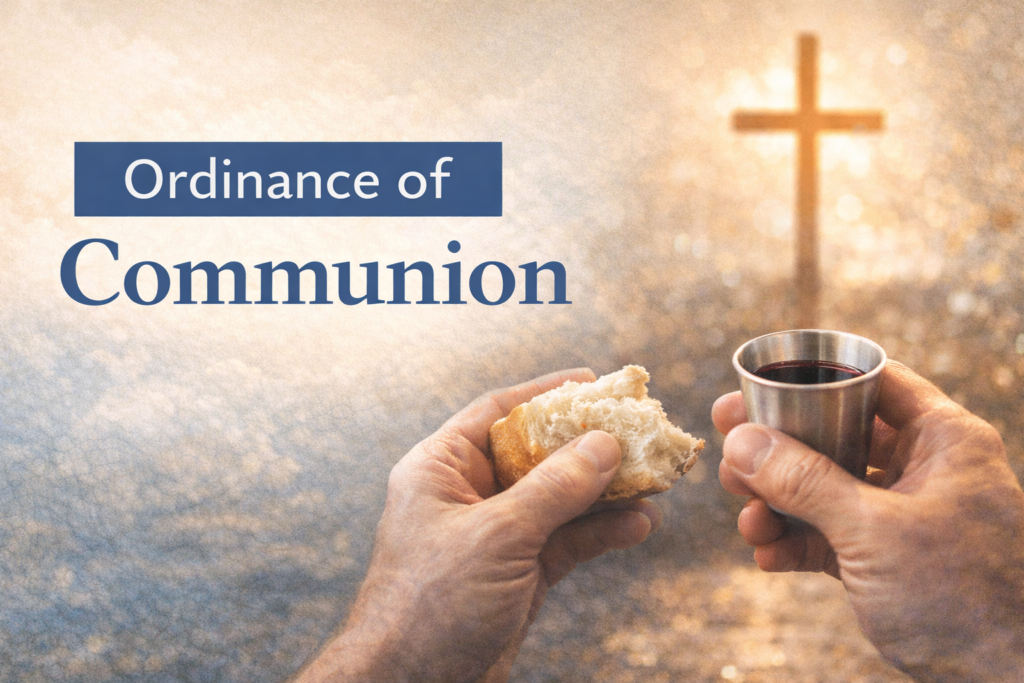
A service of communion can be a beautiful, moving and spirit-filled moment in the life of a congregation. How it is practiced is crucial to helping others understand its meaning and the power of the ritual. In protestant churches there is no one standard practice for either how often or in what manner communion is done. It varies from place to place and church to church. What follows are some helpful guidelines to aid ministers in the practice of communion.
The Bread
Communion involves the receiving of bread and wine. The bread may come in the form of a full loaf of unleavened bread; cubes of bread or crackers cut or broken into small bite-sized pieces, or wafers produced for such an occasion. Any can be used since the symbolism is in what Jesus says the bread represents. The so-called words of institution for communion are found in Paul’s letter: “For I received from the Lord what I also passed on to you: The Lord Jesus, on the night he was betrayed, took bread, and when he had given thanks, he broke it and said, ‘This is my body, which is for you; do this in remembrance of me’” (I Corinthians 11:23-24). The key theological truth in Jesus’ statement is that his body would be “broken for you.” As a result, the act of breaking the bread provides a visual expression of the suffering of Christ on the cross. If your congregation uses a loaf, the minister should break it just before serving and use the words of institution to highlight what the congregation is seeing. If you have small pieces of bread or crackers that you are using, have a loaf available to present and break. If you are using wafers, please instruct the congregation that the wafers are scored in the center (it looks like a plus sign + in the center) and instruct them to break the wafer before eating it.
The Fruit of the Vine
Communion also involves the act of drinking the fruit of the vine. With the stance of some churches opposing alcohol, they have chosen to use the unfermented juice of the grape developed by Thomas Welch for just such a purpose. The wine of the Passover meal at which Jesus instituted communion was there to symbolize sacrifice that was required for the forgiveness of sin. Some of the blood was sprinkled on the altar to remind the people that something had given its life for their forgiveness.
He got up early the next morning and built an altar at the foot of the mountain and set up twelve stone pillars representing the twelve tribes of Israel. Then he sent young Israelite men, and they offered burnt offerings and sacrificed young bulls as fellowship offerings to the Lord. Moses took half of the blood and put it in bowls, and the other half he splashed against the altar. Then he took the Book of the Covenant and read it to the people. They responded, “We will do everything the Lord has said; we will obey.” Moses then took the blood, sprinkled it on the people and said, ‘This is the blood of the covenant that the Lord has made with you in accordance with all these words.” (Exodus 24:4-8)
But half of the blood of the sacrifice was poured into bowls/cups for presentation. These cups became representative of the cup of blessing that represented God’s goodness to the Israelites in delivering and sustaining them in the wilderness. At the Last Supper the symbolism of the cup is found in the blessing of God for salvation. But the true meaning is in the color of the liquid. Again, this is reflected in the words of the institution. “In the same way, after supper he took the cup, saying, ‘This cup is the new covenant in my blood; do this, whenever you drink it, in remembrance of me’” (I Corinthians 11:25, italics mine).
The old covenant was based upon the act that the blood of the lamb would be sprinkled on the altar. Jesus now substitutes his blood on the cross for that of the sacrifice described by Moses. Jesus will be the sacrifice of “the Lamb of God, who takes away the sin of the world” (John 1:29)! Since the symbolism of the sacrifice in the cup is the red color of the blood, it is the symbolism of the drink that is recreated in communion. Therefore, red grape juice rather than white is preferred to keep the symbolism in focus.
Serving Communion
Many congregations prefer to use individual cups for communion. While these may be passed through the congregation, the solemnness of the ceremony has led most congregations to have the worshippers come forward and receive the elements from those prepared to serve. While this requires the purchase of communion trays and cups as well as someone to prepare the trays with juice, it is a tried-and-true way of serving communion. In addition, the use of individual cups like the use of already broken crackers or bread takes away from the oneness that is connected to communion. When Jesus prayed, “My prayer is not for them alone. I pray also for those who will believe in me through their message, that all of them may be one, Father, just as you are in me and I am in you. May they also be in us so that the world may believe that you have sent me” (John 17:20-21). He did so following the Last Supper and just prior to being arrested and crucified. If part of the symbolism of communion is in expressing unity, individual cups can seem counter to that notion. As a result, most congregations ask the whole congregation to wait until everyone has been served and then partake of the elements at the same time.
Another way to serve communion that preserves the idea of a common cup is to take communion by intinction (intinction is Latin for “dipping in”). In this service, bread is used, and the individual worshippers then dip their piece of bread in the common cup and eat it immediately. This provides for oneness in the common cup even though the actual consuming of the bread is done at different times. Others prefer to have one or more tables set up with communion elements in the worship center and give instruction that people may go and serve themselves at any point during the service. In any of these processes, it is the teaching about communion that is crucial to make sure that those who participate do so with understanding.
Placement in the Service
It is possible to place communion at most any point in the service as long as connection and instruction are done properly. For instance, communion can be used as a call to worship. A time of silence with soft music playing in the background can bring people into the sanctuary with a sense of reverence and awe. This requires a great deal of preparation to make sure that individual congregants know what is taking place and why. Another placement comes at the conclusion of the entire service – a kind of a benediction. In this scenario, the congregation needs to be instructed in how to proceed, but all the worshippers are already present and can easily be prepared for the event.
There is an ancient order of service referred to as the four-fold worship pattern of worship. It involves four actions in worship: gathering, Word, Table, and sending. Many churches, including most Church of God congregations, follow this pattern (though they may not be aware they are). The gathering part of worship involves everything from the prelude to the call to worship to most of the singing to the pastoral prayer. The Word section follows with the reading of scripture and the preaching of the Word. The Table section is where communion is typically done – following the sermon. In this scenario, communion is viewed as the way in which the church responds to the preaching of the Word. In churches and services where communion is not served (and sometimes even if it is) the Table section becomes the response of the congregation to the preached Word. An altar call, time of anointing and prayers for healing, testimonies, and baptisms may be placed in this section. Finally, there is the sending portion. This involved whatever charge there is to the congregation to be missional in its focus and evangelistic in its actions.
Conclusions:
Whatever the practice of communion or the placement of it in the service, it is incumbent on the minister to make sure that the congregation is properly discipled in what communion represents. While it reflects the crucifixion of Christ in the bread and wine, it also reflects the real presence of the risen Christ in the experience of sharing communion together. Communion is not just about the death of Jesus, but it is also about the resurrection of Jesus and anticipating his Second Coming. Again, the words of institution teach us this when it says, “For whenever you eat this bread and drink this cup, you proclaim the Lord’s death until he comes” (I Corinthians 11:26). In communion, the whole incarnation of Christ is represented. As the great liturgical affirmation states, “Christ has died, Christ is risen, Christ will come again.”
Since this is true, communion can be celebrated at the incarnation of Christ (Christmas); at the death of Christ (Maundy Thursday and Good Friday); at the resurrection of Christ (Easter, Pentecost) or any time the church gathers to worship the Lord. Whenever you choose to schedule communion, it is always good to use it as an opportunity to instruct and disciple the congregation in what it means to share in the Lord’s Supper.