
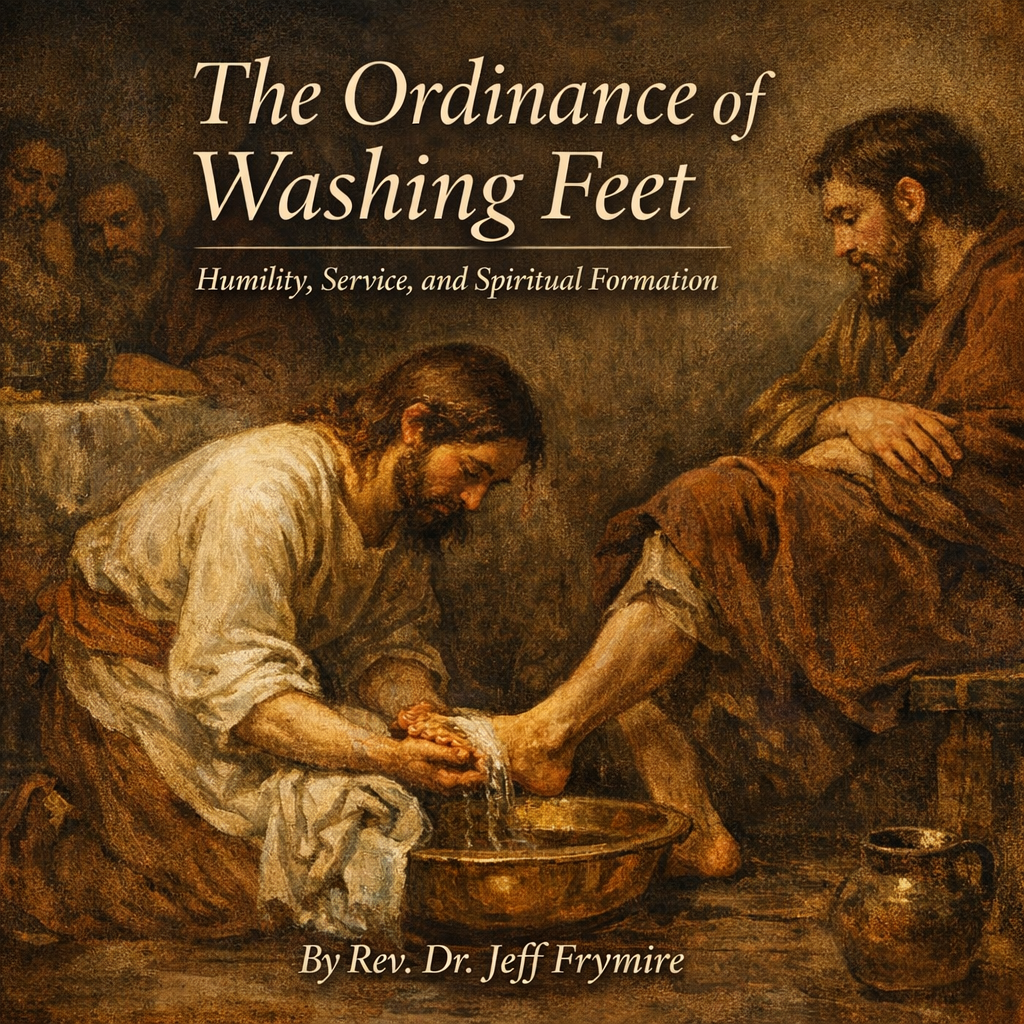
Undoubtedly the least used and understood ordinance that most churches, including the Church of God, practice is the washing of feet. Yet it is a clearly established ordinance for the church to practice and there is as strong a biblical background as there is for communion or baptism. Why is it viewed as the “least” of ordinances? Perhaps it is the intimate nature of the ordinance or the requirement of willing partners to participate in the event, that has made it less celebrated and more misunderstood. In order to fully appreciate this unique ordinance, it may be helpful to understand its origins and background.
Background
The first discussions concerning feet washing occur in the book of Genesis. Genesis suggests that it is viewed as a normal social convention when people arrive at a home. It is part of the culture of hospitality that guests should be properly welcomed and greeted. Passages such as Genesis 18:4; 19:2, 43:24 are just a few of the many occurrences of travelers being provided water to wash feet. Considering the dusty nature of roadways and the use of sandals as footwear, it is easy to see how providing water, towels, and basins were viewed as courtesy and consideration.
In passages like I Samuel 25:41, it also takes on the idea of humility. When David offers to take the newly widowed Abigail to be his wife she replies, “I am your servant and am ready to serve you and wash the feet of my lord’s servants.” By the reign of David, the ritual of washing feet had also taken on the idea of service and humility. By the New Testament period it was well established that foot washing was a socially humbling act done by servants or slaves rather than by the host.
On one occasion Luke tells us that Jesus chides a Pharisee who has invited him into his home for a feast but did not provide someone or materials to wash his feet. When a sinful woman comes over and uses her tears to wash Jesus’ feet, Jesus refuses to have her act of humility be denigrated by any in the gathering because she is a “woman of the streets.” (Luke 7:37 TLB) Jesus pointedly tells the Pharisee, “Do you see this woman? I came into your house. You did not give me any water for my feet, but she wet my feet with her tears and wiped them with her hair.” (Luke 7:44) It may very well be that this incident had a profound effect on Jesus and, along with the anointing of his feet by Mary with her expensive oil/pure nard at the house of Lazarus, that it laid the foundation for what happened at the Last Supper.
The Last Supper
The background of John 13 is quite interesting. While the Synoptic Gospels (Matthew, Mark, and Luke) all refer to the institution of communion as the key ritual performed at the Last Supper, John does not record anything about communion taking place. For John, the most important ritual performed in the Upper Room was foot washing. The ritual is so crucial to John that he takes up half the chapter sharing it in great detail. Foot washing takes up nearly one-quarter of all that Jesus says and does in the Upper Room that night. While many have relegated the washing of feet to subordinate status neither John nor Jesus treats it that way. The implication is that foot washing and communion are on equal footing when it comes to rituals and ordinances that Jesus instituted and practiced.
Another crucial aspect of John 13 is when Jesus tells the disciples, at the end of the foot washing ritual, “Now that you know these things, you will be blessed if you do them.” Some translations even use the word “happy” in place of “blessed” which may further add to the second-class view of the ritual. However, a deeper look at the text reveals a much more compelling statement than mere blessing or happiness. The Greek word “blessed” is μακάριος and it is the same word Jesus uses in the Beatitudes. Jesus’ teaching in the Beatitudes goes far beyond the modern concept of being happy and speaks to the blessing of God on one’s life even in difficult circumstances. By NewTestament times blessing carries with it the duel concept of serving and doing so as a conduit of blessing. While in baptism the candidate is describing what has happened in salvation and in communion the penitent is remembering Christ’s sacrifice for their salvation, in foot washing the worshipper is acting out the ideal of service. Jesus’ concept of blessing has with it the force of being a command. To follow Jesus in the washing of feet is to be spiritually formed as a servant just as Jesus was a servant of all.
The Elevation of Servanthood
In John 15 Jesus raises serving from a menial task done by the inferior to the highest and most important action a believer can take. “Remember what I told you: ‘A servant is not greater than his master.’” (John 15:20) As a result, proper exegesis suggests that expressing service and humility is a fundamental aspect of a faithful Christian life. This sentiment is found throughout the New Testament. For instance, Paul instructs Timothy that widows who are taken care of by the church have to be of a certain age (60), were faithful to her husband, and “and is well known for her good deeds, such as bringing up children, showing hospitality, washing the feet of the Lord’s people, helping those in trouble and devoting herself to all kinds of good deeds.” Even more so, Paul exhorts the Philippians:
Therefore if you have any encouragement from being united with Christ, if any comfort from his love, if any common sharing in the Spirit, if any tenderness and compassion, then make my joy complete by being like-minded, having the same love, being one in spirit and of one mind. Do nothing out of selfish ambition or vain conceit. Rather, in humility value others above yourselves, not looking to your own interests but each of you to the interests of the others. In your relationships with one another, have the same mindset as Christ Jesus: Who, being in very nature God, did not consider equality with God something to be used to his own advantage; rather, he made himself nothing by taking the very nature of a servant, being made in human likeness. And being found in appearance as a man, he humbled himself by becoming obedient to death—even death on a cross!
Philippians 2:1-8
The elevation of the role of the servant to the high status bestowed by Jesus means that the act of foot washing, while a strange social custom to us today, remains a primary way to remind believers that service is the highest calling of Christians. While not everyone is musical nor are all called to preach, serving is a universal gift that Christians should use to express the gospel. Foot washing accomplishes the goal of understanding service as a high and important Christian virtue.
Foot Washing as Intentionality
Jesus takes a premeditated action when he interrupts the Passover celebration to insert foot washing into a highly ritualized meal. Foot washing is not normally a part of the Seder meal, though service is an important part of the liturgy. It appears evident that Jesus intended to make a point by washing the feet of the disciples during the meal and that point was greater than his own view of servanthood. The question is: what is the deeper point Jesus is making?
In the text, John (John 13) writes that the meal was “in progress” and Jesus was aware that “the devil had already prompted Judas… to betray Jesus.” The most straightforward conclusion is that Jesus intentionally introduced this ritual to be used by the disciples going forward. The immediate need was to have something in place that could help restore and unify the disciples after their relationship with one another and with Jesus would be fractured by their actions of fear, cowardice, denial, and betrayal. Foot washing is a powerful tool that the church can use in restoring shattered relationships. Jesus chose whose feet he would wash. Remember, two of the twelve were singled out that night for betrayal and denial (Judas in vs. 26-27 and Peter in vs. 31-38). Jesus chose that night to wash the feet of those who would be operating in opposition to him during the arrest and crucifixion. The washing of feet was, in part, created to be used in the future to bring the group together as one. The intimacy of the act of sharing and the personal connection to the group was intended to help them find a renewed unity. That is why he concludes the service with the admonition, “Very truly I tell you, no servant is greater than his master, nor is a messenger greater than the one who sent him. Now that you know these things, you will be blessed if you do them.” (John 13:16-17)
Notice the process Jesus used that night. He washed the feet of all twelve of the disciples. None of them washed his feet. His action was to express his own humility and that by going to the cross he was serving them. Washing feet was a perfect symbol of Jesus sacrificial attitude on the cross in the same way bread and wine were a perfect symbol for his action on the cross. The two ordinances combine to portray what Jesus was doing at the Cross on the inside (foot washing) and on the outside (communion).
Practice and Procedures
Churches have historically expressed the practice of foot washing during the celebration of the Last Supper on Maundy Thursday during Holy Week. This follows the historical practice of the early church. Many of the ancient church fathers – luminaries such as Tertullian, St. John Chrysostom, Athanasius, Ambrose, and Augustine – all mention the washing of feet as crucial to a believer’s spiritual formation and practice. So, based on these historical and biblical understandings, how should foot washing be practiced today?
The primary reason for a foot washing service is often misunderstood. Foot washing was designed for people to wash the feet of another person rather than have their own feet washed. It appears customary in today’s church for participants to pair off, have their feet washed, and then wash the feet of the one who has washed their feet. The problem is our practice does not really reflect what Jesus did in the Upper Room. The impact of what Jesus did was based on the fact that he washed the feet of the disciples. That act of humility, stooping and serving as though a menial servant is what Peter balks at during the meal. He’s not objecting to the idea of having his feet washed (a servant had probably already done that when they entered the room) but who was doing the washing. It was not the act that was difficult to accept but the humility of servanthood portrayed by Jesus. Peter struggled to equate the Messiah with a slave’s action. What this teaches us is that it is the actual washing of another’s feet that we truly understand the ordinance.
Secondly, it is important to note that Jesus intentionally washed the feet of all twelve of the disciples. He intentionally invited all of them to the feast while actively working to provide preparations for the meal. This act has profound implications for how we do foot washing today. Whatever a participant does during the washing of feet, it should be intentional. Choosing whose feet wash needs to be an intentional choice. Notice that Jesus washed the feet of those he loved (the Disciples) even John who described himself as “the one whom Jesus loved.” But in the same act he washed the feet of the one who was to deny him three times (Peter) and the one who would betray him with a kiss (Judas). When worshippers gather to wash feet they should intentionally choose whose feet they wash. It can be someone they love, someone that has wronged them, or someone that has betrayed them. They can wash the feet of someone they respect or someone they struggle with relationally. They can choose to wash the feet of a beloved friend or difficult colleague. The key is they must be intentional in choosing whose feet they wash. Jesus chose to wash all twelve disciples. That’s not a requirement but choosing whose feet you wash is part of the humility of the service. It was one thing to wash John’s feet (the one whom Jesus loved) and another to wash Judas’ feet (the one who would betray him).
Finally, it is common to serve communion and wash feet on Maundy Thursday. Traditionally the church gathers to share in the Lord’s Supper in the sanctuary and then they are dismissed to rooms for men and women to wash feet separately. The church must set up rooms, provide basins, towels, and a water source that is easily accessible for both groups. Many choose to use dim lights or even candlelight to create a more solemn and introspective atmosphere. The participants often sing music, as was done following the Passover meal. All this is common for a Maundy Thursday service. Be creative in setting the mood and the scene. But is Maundy Thursday the only appropriate time for foot washing?
There are other settings where foot washing is appropriate. It’s possible to do a demonstration during a worship service as a way of introducing it to the larger church. Simply recruit two folks to wash each other’s feet while it is being explained to the congregation. It can be quite effective.
It can be quite moving to have elders or elected leaders at a leadership or staff retreat conclude their time together by washing one another’s feet. Try it with a youth group at the beach or a women’s retreat at a lake. Again, be creative and have a specific purpose of focus for doing the service.
Because of the nature of the service and how Jesus washed Peter and Judas’ feet it can be a powerful service done after a congregation has gone through internal conflict or some kind of relational difficulty. If two people on opposite sides of a problem can come together and wash one another’s feet, it can go a long way toward healing and wholeness.
This same sentiment can also apply to any situation where a congregation or individual congregants have had tensions or disagreements. Use it for a racial reconciliation service where two different racial groups are coming together. Any situation where relationships need resolution or when people are parting under difficult circumstances can lend itself to a foot washing service.
It can be a great service for the commissioning of those who serve the congregation (ushers, custodial staff, office workers, nursery workers, children’s workers, etc.). It might be most effective if the pastoral staff is the one washing the feet of those who volunteer and serve.
Whatever the prompting, the washing of feet can help foster humility, bring about reconciliation, and elevate the importance of service in the name of Christ.