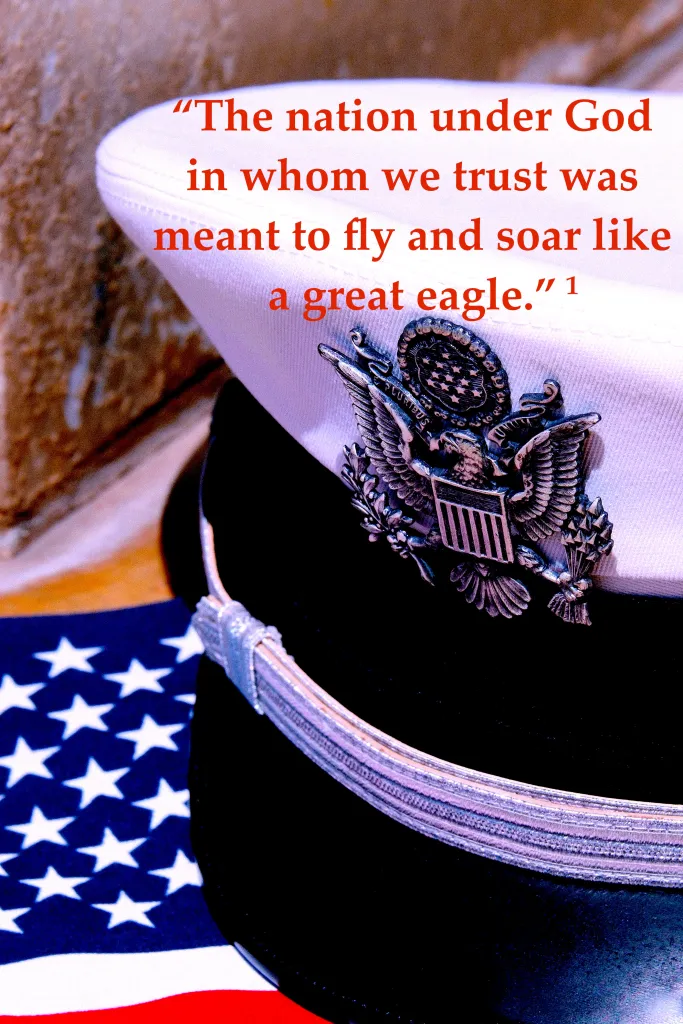
An American flag rippling in the breeze, the bigger the flag the better. A spinner with an American flag and eagle twirling in the wind outside my window. A patriotic song filling the air around me and instinctively I sing along with it. Reminders all around as we begin to celebrate the 250th year of the founding of our country.
What are we celebrating? The fireworks, friend and family get-togethers, the food, fun and festiveness? All good things—things I’ve done and enjoyed over the years. Diving deeply into my copy of The Founder’s Bible to learn more about freedom and liberty, I found more—much more to celebrate. While I only touched the surface of a wealth of information and ways to look at freedom and liberty, I found in celebration it can touch the deepest depths of our being.
The documents to govern the USA began 250 years ago with the Declaration of Independence (1776), a few years later, the Constitution (1778), and then the Bill of Rights (1791). Three documents written in such a way that they were an attempt to uphold the dignity and worth of humanity which is made in the image of God. Freedom and liberty come from God, not from government. Tired of oppression from human rule, the British Crown, the founding fathers were trying to affirm what the Bible teaches.
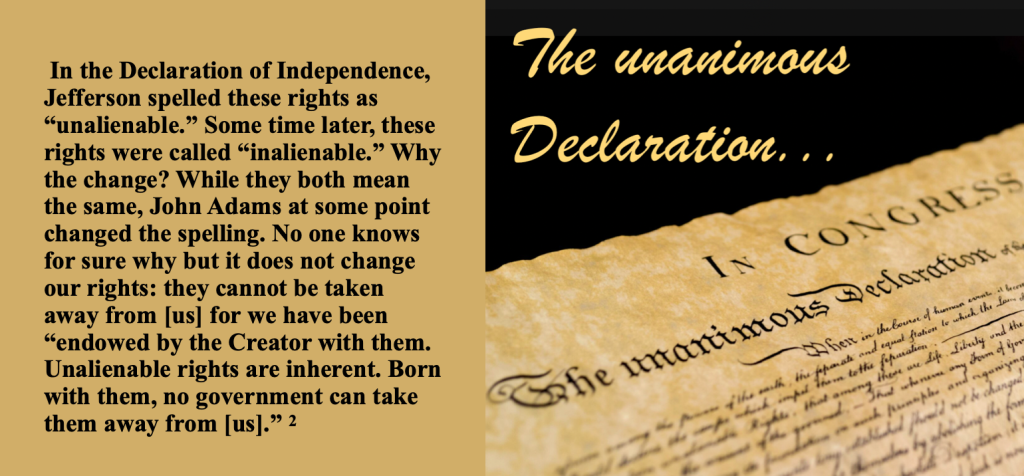
The Declaration of Independence not only states every person is created equal but also “endowed by their Creator with certain unalienable rights.” With a sense of the transcendent—of a Creator God—we know there is more to reality than just what is seen. With these abilities given to us by God, we can and should look along or through in depth as well as look at what gives us this liberty.
Juan Merced takes these God-given abilities a step further when he draws together the importance of human nature: “We are neither merely souls, nor sophisticated machines, but embodied souls or beings existing at the interface or intersection of the material and spiritual dimensions of reality.” From the very beginning, God planned for us to be aware of more than just what is visible or material—to know Him that is invisible.
Our “dignity and worth” is validated as image-bearers and our intuitive abilities remind us we are “responsible for our moral choices.”3 We have the potential to experience the full scope of what it means to be made in God’s image. The biblical worldview that embraces the Judeo-Christian faith will do that. Realizing this, the Founders embedded it into the foundation of the Declaration of Independence.
THE REAL REVOLUTION CAME BEFORE THE WAR
Liberty was often in the hearts and minds of our Founding Fathers as they processed what it would take to develop and maintain a government of the people, by the people and for the people. Willing to die for this liberty, it was of greater value than freedom.
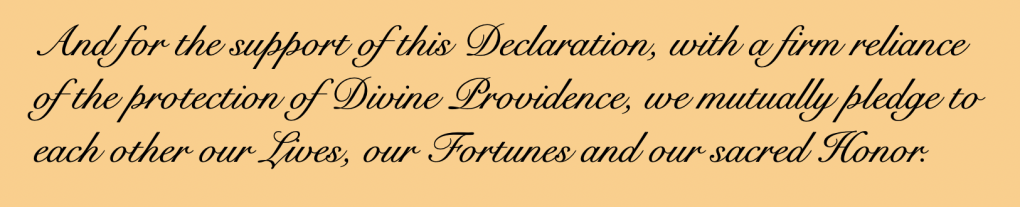
The men who signed this declaration knew it was putting at risk the loss of their lives. It was verified in the final words of the document as they claimed the support of this Declaration was their firm reliance on God’s divine protection as they then pledged to each other who were signing it, their lives, fortunes and honor. This document was considered radical and took a lot of courage.4
When working on this blog, the title of an article caught my attention: “The Founding Fathers Had a Real Revolution to Overcome Before They Could Win the War.” Many issues must be overcome to create a government never having been tried before.
Years later when asked what was meant by “the American Revolution,” John Adams indicated he and the other Founding Fathers, had to deal with more than a physical revolution. The idea of a “revolution was in the hearts and minds of the people” long before any shots were fired. Not only was it in their “duties and obligations” but “their religious sentiments” as well.
People in the various different colonies were diverse in “their religious sentiments” creating “America’s first struggle.” While very diverse, they came “to America mainly for religious freedom.” Needing to come together to create this new government, the men composing the Congress had their work cut out for them as to how they would address the “many different nations, customs, manners and habits … especially their religious beliefs” among the people who had settled in these colonies.
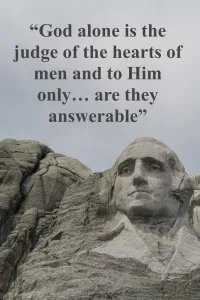
When one colony’s British authority imprisoned several ministers of a different persuasion because they had no license from the Church of England, “James Madison and Thomas Jefferson reacted by calling for the free exercise of religion throughout the colonies.” George Washington and others realized “God alone is the judge of the hearts of men and to Him only… are they answerable” when it comes to violating the rights of others that have different views concerning the practice of religion.
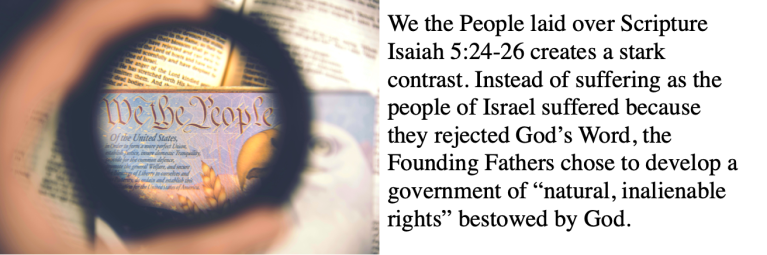
The freedom of religion eventually was “enshrined” in the Bill of Rights. The common ground came from the “natural, inalienable rights” endowed by God not the government.5 Paul said about this freedom when he wrote: “So Christ has truly set us free. Now make sure you stay free, and don’t get tied up again in slavery to the law” (Galatians 5:1).
FREEDOM VS LIBERTY
As with Paul, the goal of our Founders was to stay free and not get tied up again in slavery to the law or in other words “freedom from law-based bondage.” The commentary in The Founder’s Bible entitled, “Freedom Versus Liberty,” goes into great detail about freedom and liberty and their impact on the early days of the founding of America. While both are often used interchangeable, David Barton brought up a difference: Freedom is having the opportunity to make choices—God gives each person an opportunity to choose God’s way or his or her own way.7
These choices began with Adam, the first man. His first choice given by God was to choose what plants he could eat. He was given the freedom to eat from everything except for one tree—the tree of the knowledge of good and evil (Genesis 2:15-17). Adam was not prevented from eating of the tree: it was a choice he was given. Clearly God knew he could easily make the wrong choice just as we do today.
Without choice, Adam would not learn the value of making the choice to obey God. To not have this freedom, he would “be like a prisoner with his obedience only a hollow” ritual. When given choice, it was on him. Adam would find when being obedient, he was awarded; when disobedient, he paid the price of consequences.8
“Independence to do what one wants… do as one pleases” has been described as freedom. There is a “potential deficiency” found in this description of freedom. Not one person on earth has permission to do anything he or she wants. Parameters are set up in a variety of ways, places and actions. Such as not infringing on another person’s rights; we must consider a person’s space, individuality and personhood. If we would choose, as many have over the years, to encroach on the rights of another person, this is a violation of not only that person but the laws of civilization.
Thomas Jefferson recognized God our Creator gave humanity some unalienable rights; he believed liberty was only second to life itself. Made with a “mind, will, emotions and spirit” ingrained within us, we are made in God’s image, He has placed within us the opportunity for liberty as well as intuition and instinct. When we intentionally place these in God’s care, we’re given “the capacity for self-government … Freedom is something the government grants; liberty given to us by God is something we own that a government cannot take away.”
BOTH LIBERTY AND FREEDOM ARE POSSIBLE IN A CONSTITUTIONAL REPUBLIC
Our Founders realized the importance of liberty for each individual person when setting up the right kind of government. Thus, people would have the freedom to vote for the leaders in their government; they considered and developed what it would take so freedom would not be negated when the people voted. For our government to succeed, it must be a constitutional republic instead of a democracy. This gives us the opportunity to vote elected officials out of office.

John Adams made it clear, that if only a democracy was sought, it would not last long. He clarified why: “It soon wastes, exhausts, and murders itself.” In his experience, “there never was a democracy yet that did not commit suicide.” It does not work for in the midst of it, the people suffer.
Rather than the majority ruling our American republic or the elected officials having the authority, it is the Constitution that has authority. For we are all subject including the officials. In our case, the laws written in the Constitution have been based mostly on the Bible—on the laws given to us by our Creator.
America’s government is not a democracy, thus, we are not at the whims of the majority rule. Instead, liberty is one of our inalienable rights granted to us not by the government but by God. As long as we adhere to the Constitution, our rights cannot be “rightfully taken away.”9
OLD DELUDER SATAN LAW
The original colonists chose to take the chance to journey for days on an ocean below them and sky above. The destination, America, a place upon which they had never laid eyes. All because, they desired religious freedom. The magnitude of this need took me deeper into the issues. This statement began the quest: “When those early colonists arrived, the Bible was still a relatively new book to them, having been sealed up for centuries.”
The question: Why such little knowledge of God’s Word? For many centuries especially during the Dark Ages, only a few of the elite, could read and write. Persecution was rampant in Europe. Rather than sharing the good news of Christ, the complete Word of God was kept from the people, and thus, used to control. Evil leaders indicated the “Bible required both State and Church to rule its citizens with a heavy hand.” The common people’s duty was to turn those in who did not follow the Church and State rulings.
Once the printing press was invented, Bibles were more available. The wicked leaders, not foiled, went after those who made it available to the common people. William Tyndale—a known name to this day—was one of such martyrs. This was the “world” the colonists took voyage to escape. Once able to examine Scripture for themselves, they “saw how dramatically God’s Word actually differed from what they were told.”
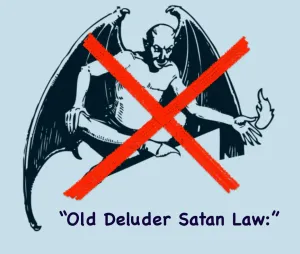 As the Bible came alive to them, the early colonists wrote and deliberately “enacted America’s first public education law to prevent the abuse of power that can be imposed on a Biblically illiterate people… It being one chief project of that old deluder, Satan, to keep men, from the knowledge of the Scriptures, as in former times by keeping them [the Scriptures] in an unknown tongue… [with] the Lord assisting our endeavors, it is therefore ordered…to teach all children… to write and read.”10
Conspiracy to withhold truth from people has gone on since Adam met the serpent in Genesis. Paul wrote as evil continued to arise: “This matter arose because some false believers infiltrated our ranks to spy on the freedom we have in Christ Jesus and to make us slaves” (Galatians 2:4). Those false believers who spied on Paul and other Christians wanted to “spy out” their liberty for deceitful intentions. That intention was to find a way to re-enslave them to the Old Testament laws.
The Greek word for liberty,“Eleutheria, signifies a liberating reality believers possess in Christ.” When we believe in Him, God releases every form of spiritual bondage so we serve Him “willingly, joyfully, and fruitfully.” Freedom is gained when pursuing holiness through the empowerment of the Holy Spirit not through legalistic religion.11
One can have freedom without liberty. Yet, to have liberty, we must know the difference between it and freedom. Freedom is something the government grants; liberty is something we own and the government cannot take away as it is God-given.
DISCERNING INTENDED PURPOSE OF THE CONSTITUTION
To discern and understand, we must look along—go deeper into God’s Word: “But we know that the Law is good, if one uses it lawfully” (1 Timothy1:8). “Under God’s sovereign design, when we use the things He has given us in the means He designed for them to be used, we enjoy the blessings He intended, but if we use the same things in ways He did not intend, they become destructive.”12
Thomas Jefferson discerned what still rings true today if we want to continue to use it lawfully. He said this when advising the Supreme Court Justice, William Johnson: “On every question of construction, carry ourselves back to the time with the Constitution was adopted, recollect the spirit manifested in the debates, and instead of trying what meaning may be squeezed out of the text or invented against it, conform to the probable one in which it was passed.”13
“So Christ has truly set us free. Now make sure you stay free, and don’t get tied up again in slavery to the law” (Galatians 5:1). By standing firm in Christ, we can stay free for only in Him do we find liberty. And with liberty we have freedom.
This article does not reflect the opinion of all members of the Vital Words Executive Committee
Notes:
1Cummings, Brad, Lance Wubbles: gen. ed. (David Barton, Signature Historian). The Founders Bible. Newbury Park, CA: Shiloh Road Publishers,LLC. 2012:1251
2 “Unalienable or Inalienable.” Civic and Citizenship. retrieved on 6.24.26 from https://civicsandcitizenship.org/unalienable-or-inalienable-which-right-is-correct/
3Merced, Juan. “The missing Melody.” Salvo. Spring, 2026. p. 29-31.
4 [Hanson, Fred. “Declaring Independence Was Risky for Founding Fathers.” (7.03.2019) Patriot Ledger. retrieved on 6.23.26 from https://www.patriotledger.com/story/news/2019/07/03/declaring-independence-was-risky-for/4766396007/
5Cook, Jane Hampton. “The Founding Fathers Had a Real Revolution to Overcome Before They Could Win the War.” Fox News online. retrieved 6.22.26 from https://www.foxnews.com/opinion/founding-fathers-real-revolution-overcome-could-win-war.
6 Barton, David. “Freedom Versus Liberty.” The Founders Bible. Newbury Park, CA: Shiloh Road Publishers,LLC. 2012:1860-1861
7 Ibid: 2069-2071
8 Beers, Ronald A, Gen Ed. Life Application Study Bible, Third Edition. Carol Steam. IL: Tyndale House Publishers, Inc. 2019:8
9 Barton. 1860-1861
10 Ibid. 2069-2071
11Greek: Eleutheria. Biblehub. retrieved on 6.8.26 from https://biblehub.com/text/galatians/2-4.htm 9 F’sB 1838
12Barton. 1838
13[Thomas Jefferson quote. Thomas Jefferson Foundation:2026. retrieved on 6.26.26 from https://tjrs.monticello.org/letter/417
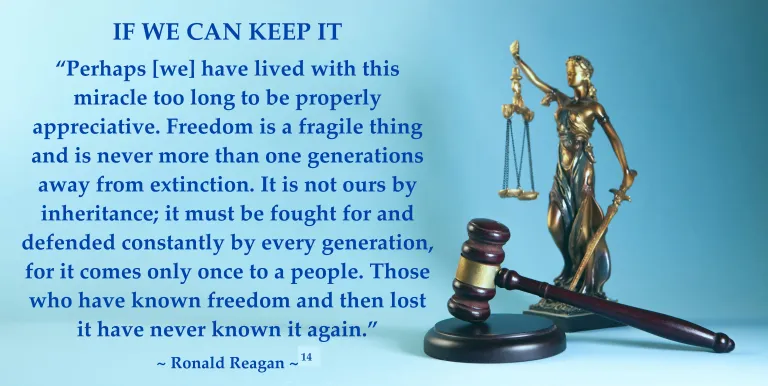
14Barton 2215
Eagle on cap/Flag Photo by Wesley Tingey on Unsplash
Declaration https://duckduckgo.com/?t=ffab&q=Declaration+of+Independence&ia=images&iax=images&iai=https%3A%2F%2Fs35049.pcdn.co%2Fwp-content%2Fuploads%2F2021%2F06%2FDeclaration-of-Independence-scaled.jpg
Last words of Declaration https://www.britannica.com/event/American-civil-rights-movement
George Washinton Photo by laura-nyhuis-XYa5vrN1W0w-
We the People Photo by Anthony Garand on Unsplash
Wolves Photo by Sibeesh Venu on Unsplash
Lamb and Cross Photo by Jasmin Staab on Unsplash
Devil Drawing from Openverse
Lady Justice Photo by Sasun Bughdaryan on Unsplash