Defining Ordinances vs. Sacraments
When Christian groups speak about baptism or communion, they do so with differing language. Most particularly, they talk about them either as an ordinance or as a sacrament. There is significant difference between the two terms and, hence, in what they mean or claim. Before determining how these actions are to be approached, performed, and taught it is essential that ministers grasp the difference between these two terms. They represent two very different theological approaches.
A sacrament is described as a means of grace. By participating in an activity, the worshipper receives grace for the forgiveness of their sins. This is why numerous groups practice weekly communion during services or require baptism in order to become a Christian. Primarily this is because they are viewed as acts of God in which the believer participates. God infuses the elements with his grace, and we receive that grace when we do the act. Those who teach this doctrine will often talk of things like the transubstantiation (i.e. the substance is transformed) of the communion elements because the elements are the conduit through which grace is bestowed on the penitent. Others will talk about how we should remember our baptism as a way of remembering our salvation since a confession of faith is not enough to confer grace. It must come through an act, such as baptism, for us to receive the full pardon for our sins.
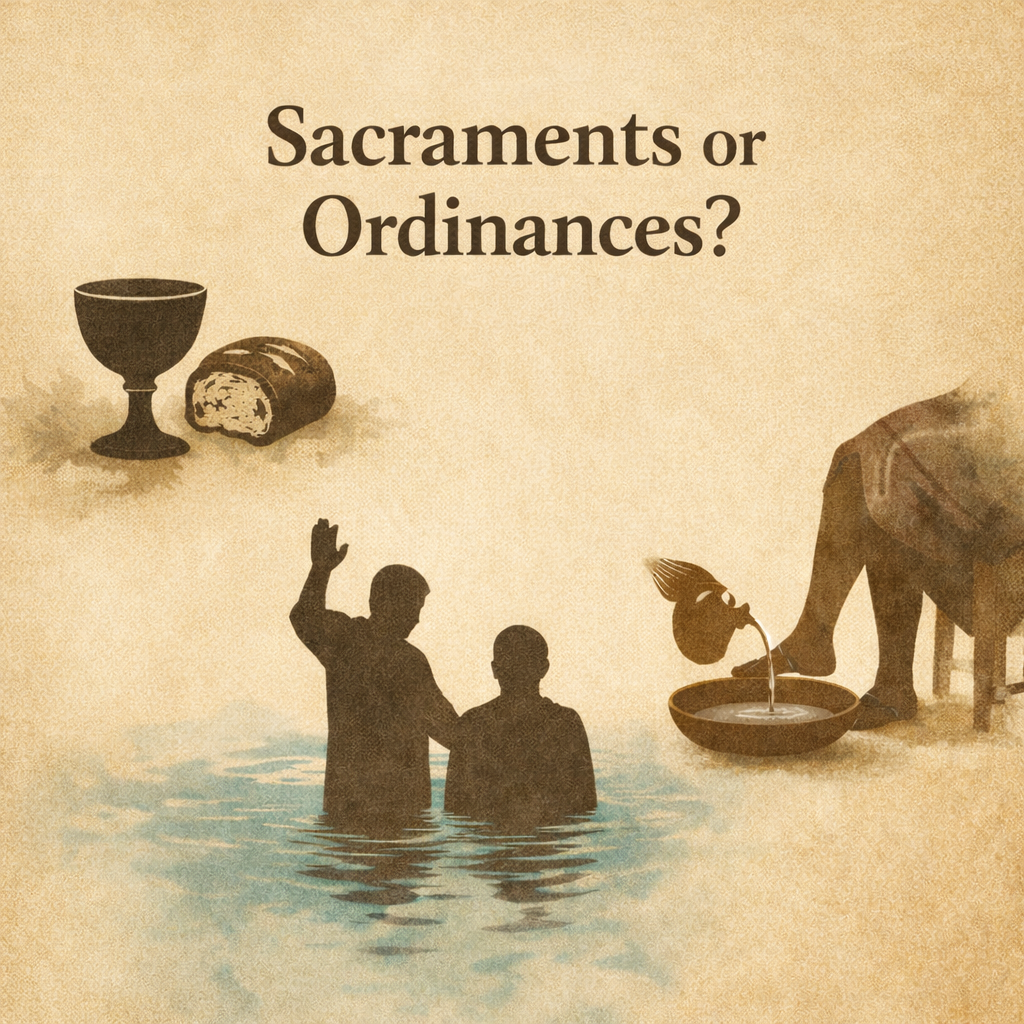
An ordinance is ritual that has been ordained by God. The Church of God believes that these actions (communion, baptism, and the washing of feet) are not a means of grace but actions that we are commanded to do in scripture. Like the Passover celebration of the Old Testament, believers gather together to participate in a divinely commanded ritual through which we express our faith in Christ. As such, all three actions (baptism, communion, and feet-washing) are considered activates that we do after we are saved by grace rather than activities we must do to receive grace. None of them, in themselves, can save the penitent, rather they are part of the spiritual formation of the believer. That is why these practices are to be performed by the believing community as a response to faith in Christ. This does not imply that grace may not be received at some point in the ritual (God is sovereign and can do what He wills) but it does claim that such grace would be God’s response to the believers faith rather than to the mere action of eating and drinking bread and juice, being sprinkled or immersed in water, or doing an act of service/humility to someone else.
Neither does this stance deny that there is a real presence of Christ at these moments. For instance, the act of communion celebrates not only the death of Christ on the Cross, but it celebrates the resurrection of Christ and, indeed, anticipates his second coming. This is one of the reasons why we believe in an Open Table. John Wesley’s view was that someone may find grace on the way to the Table. God can save someone in the act of remembrance if their hearts are turned toward God. If you read the words of institution from Paul in I Corinthians 11, he gives caution for those who come for communion that they do not eat and drink unworthily. While there is much there to unpack, Paul is reminding us that even at an Open Table, those who partake of communion should think soberly about what they believe and who they worship.
Calvinist vs. Wesleyanism Practice
The theological framework of the church that practices these rituals also affects how they are perceived and practiced. For instance, in more Reformed or Calvinistic theology church groups communion is often a weekly activity. Primarily this is related to the doctrine of total depravity. Since human beings are completely depraved it is only through God’s determinative action that people can be saved. Rather than being a response to faith, grace is an act done by God from outside of us. He elects those that shall be saved and he saves them. Since sinful humankind cannot even respond to God’s offer of grace, it is God who must reach down and save the sinner. Their participation is as receiver of God’s grace rather than an actor who responds to the offer of God’s forgiveness. Since we are in a continual state of sin and sinning (the Calvinist says, “Sin you will, sin you must”) the importance of communion is vital in order to wipe away the weekly sins that even the most faithful believer commits continually. Like the Day of Atonement in the Old Testament, the community gathers to receive forgiveness each week from a God who meets you in the ritual (Temple for the Jews, Sanctuary for the Christian). Similarly, baptism is what saves the believer. Once they realize that they are part of the Elect, the new “Christian” must profess that faith through the sacrament of baptism. In other communions, parents are told that they must bring their newborns to the church for baptism so that if they die, they will not die in their sins. Baptism as an infant ritual is a sacramental act that prepares the child to realize that they are part of the Elect as they grow to maturity and protects them in case of death.
In Wesleyan theology the act of communion is an act of faith. Worshippers are encouraged to follow the admonition of the Apostle Paul and his teaching on communion.
So then, whoever eats the bread or drinks the cup of the Lord in an unworthy manner will be guilty of sinning against the body and blood of the Lord. Everyone ought to examine themselves before they eat of the bread and drink from the cup. For those who eat and drink without discerning the body of Christ eat and drink judgment on themselves.
I Corinthians 11:27-29
This seems to clearly teach that communion is a responsive act that involves the examination of one’s spiritual life to see if it measures up to the faith being expressed in the act of communion. As a result, grace is freely available to anyone who comes to the Table to eat and drink. Wesleyans embrace the concept of the “open table” wherein all are encouraged to participate in communion in the hopes that they may receive salvation even in the act of coming to the Table. However, grace is afforded to those who receive Christ through faith not through mere ritual.
In a similar way, those of the Wesleyan theological expression view baptism as an affirmation of a faith already received. After being saved by a profession of faith in Christ as Lord and Savior, baptism becomes not a seal on that profession but a witness to what God has already done. Baptismal candidates are not saved by water but use the ritual of baptism to testify to the salvation already received through faith. While communion can be used as a time of confession (“Everyone ought to examine themselves..”) baptism is used as an act of profession of ones conversion to Christ. It is a public witness of a personal commitment that is then blessed by God.
How Doctrine Affects Practice
Those churches that believe in sacraments believe that frequent practices of these rituals are necessary – weekly communion, immediate baptism, baptism for the remission of sins, infant baptism – and must be practiced regularly by sin-filled believers seeking redemption.
Church of God practice responds to a theological understanding that realizes that frequent or immediate practice of these ordinances is valuable but no necessary for salvation nor are they a means of grace. As a result, ministers should be judicious when referring to these ritual practices as sacraments. They are holy rituals, commanded by God to be performed by the believing community. A primary understanding of that comes through the act of Feet Washing. Church of God doctrine takes seriously the admonition that Jesus gives his disciples at the Last Supper. “Now that I, your Lord and Teacher, have washed your feet, you also should wash one another’s feet.” (John 13:14) While some attack the use of the word “should” to be less than a command, it needs to be noted that the Greek word used here for should – ποιέω (poieō) – occurs 602 times in 519 verses in the Greek concordance including the following (with the translation of ποιέω in italics and underlined):
- “Come, follow me,” Jesus said, “and I will send you out to fish for people.” (Matthew 4:19)
- Not everyone who says to me, ‘Lord, Lord,’ will enter the kingdom of heaven, but only the one who does the will of my Father in heaven. (Matthew 7:21)
- The disciples went and did as Jesus had directed them (Matthew 21:6)
- Jesus replied, “You do not realize now what I am doing, but later you will understand.” (John 13:7)
It certainly appears from these texts and many others that ποιέω carries with it the force of a command and an action. Therefore, Church of God congregations carry on the tradition of the ritual that Jesus commanded in the Upper Room. We do so not as a sacrament (though grace may be received, expressed, and experienced in the ritual) but as an ordinance done in obedience to the clear command of Christ.
Conclusions
The Church of God practices and believes in communion, baptism and the washing of feet. We do so as ordinances, believing them to be holy rituals we are commanded to do as a response to the salvation that God has already bestowed upon as at our conversion. Communion is practiced at special times or even on a regular basis in conjunction with the decisions of the pastor and congregation. Baptism is practiced whenever needed as people come to the realization that they need to give public witness to their faith in Christ. A foot washing service is typically done on Maundy Thursday as part of the recreation of the Last Supper. Churches gather to share in communion and then are dismissed to smaller groups to practice the washing of feet. Many churches practice the washing of feet as an act of teaching and practicing leadership. Board members, church leaders, and pastoral staff may gather to affirm and be discipled into their roles as leaders. Foot washing provided a powerful servant model for leaders to practice.
Since the ordinances are ritual expressions of faith and not actions that bestow grace, children who have accepted Christ as Savior and who are able to articulate an understanding of the meaning of these rituals are encouraged to attend and participate in communion, baptism, and foot washing. Parents have the major responsibility of teaching their children what these rituals mean and how (and at what age) they should be practiced. Because they are discipleship actions, those who are strong in the faith and have been discipled into their understanding of salvation should be ready to practice any and all of these when called upon to share. Calling them ordinances does not diminish the importance and need for sharing in these rituals.