
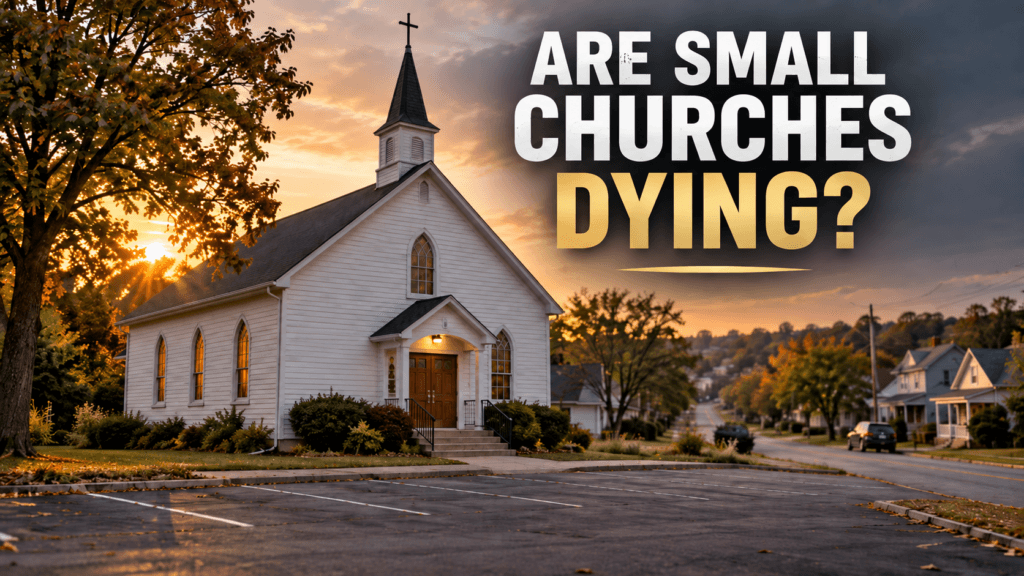
A conversation came up this past week about small churches and declining church attendance, and it stuck with me. We were talking about churches that used to be full, or at least fuller, and what has happened to some of them over the last ten or twenty years. COVID came up too, because for several churches I know personally, the drop during and after COVID was hard to miss.
That got me looking around online to see whether what I had seen locally was actually part of something larger. During that search I ran across a recent Gospel Coalition article called “The Little White Church Is Empty.” It looks at small and rural churches in Iowa dealing with declining church attendance, aging congregations, shrinking towns, difficulty finding pastors, and fewer younger families coming through the doors.
It sounded familiar.
I’ve watched a local church that has been part of its community for well over a century change dramatically. At one time it was part of the neighborhood in ways that went far beyond Sunday morning. Families knew the church because of things like its pumpkin patch and community activities. Kids came through. Parents came through. The church property itself became part of the rhythm of the neighborhood.
Over the last decade or so, much of that disappeared. The congregation became smaller, COVID certainly didn’t help, and some of the traditions that once brought the church and neighborhood together stopped happening.
I’ve seen something similar happen to another church that was an important part of my own childhood. Maybe you’ve watched it happen too.
The numbers suggest we aren’t imagining it. Gallup has tracked a long decline in regular church attendance in the United States, while Pew Research found in 2025 that only about a quarter of American adults said they attended religious services in person at least once a week. Research from the Hartford Institute for Religion Research also shows just how much American church life has changed over the last few decades.
So, are small churches dying?
Some certainly are closing. Others are shrinking. But the larger picture is more complicated than simply saying Americans have stopped going to church.
Small Churches Are Still the Norm
According to the 2025 Faith Communities Today study from the Hartford Institute for Religion Research, the median American congregation has about 70 regular worshipers. In other words, the church with 50, 60, or 70 people on Sunday morning isn’t unusual. It is much closer to the typical American church than the massive campuses many of us picture when we think about church growth.
At the same time, most churchgoers are not attending those smaller congregations.
Hartford found that congregations with 100 people or fewer make up a large majority of smaller churches while accounting for only a relatively small share of worshipers. On the other side, most worshipers are increasingly concentrated in larger congregations.
That tells us something important. We may not simply be watching people leave church. We may also be watching church attendance become concentrated in a smaller number of larger churches.
I’m part of that story myself. As I worked my way back toward regular weekly church attendance, I eventually landed at the largest church in my small town.
There are plenty of good reasons people choose a large church or even a megachurch. Strong children’s ministries matter when you have kids. So do youth programs, small groups, counseling, worship, classes, ministries for different stages of life, and the ability to find people going through the same things you are. A large church can offer things a congregation of forty simply may not have the people or money to provide.
That isn’t an argument against megachurches. If your church has 2,000, 5,000, or 20,000 people, I’m certainly not suggesting you should leave and find the smallest congregation available. In fact, I believe getting more people into church, whether that church is large or small, is a good thing.
Size isn’t the enemy.
But I do think we need to pay attention to what happens when church life becomes increasingly concentrated in a smaller number of very large congregations while hundreds of smaller local churches struggle only a few miles away.
Because this isn’t only a numbers story.
It’s also a neighborhood story.
What Happens When a Small Church Fades From a Community?
For much of American history, the local church was part of the backbone of the town, and it was literally local. The people sitting beside you often lived near you. Their children went to school with your children. You saw them at the grocery store, at community events, and sometimes over the back fence.
Today I go to church with people who live almost an hour away. There is nothing wrong with that, but it shows how much the idea of a local church has changed.
Churches used to be deeply woven into the fabric of neighborhoods and small towns.
That phrase, fabric of the community, matters here. A community isn’t held together only by government services, businesses, schools, or social media groups. It is also held together by places where people repeatedly meet one another, know one another, help one another, and notice when someone is missing.
Churches have historically been one of those places.
When a church held the pumpkin patch, hosted the meal, helped the family whose house burned, collected food, checked on the widow down the street, or opened its building when the community needed somewhere to gather, it wasn’t merely advertising itself.
It was being present.
The Decline of a Small Church Is Also a Community Story
The decline of a small church isn’t only a church attendance story. It can also become a community story. When a neighborhood church closes or becomes disconnected from the people around it, the community may lose one of the places where neighbors regularly meet, serve, worship, and care for one another.
It is easy to turn church attendance into a consumer decision. Which church has the preaching I like? Which has the music? Which has the children’s program? Which service fits my schedule?
Those aren’t meaningless questions. I ask some of them too.
But Christianity also asks us another question.
Who is my neighbor?
A church with 50 people can still be alive, faithful, generous, and deeply connected to its community. Attendance tells us something, but it doesn’t tell us everything. What matters just as much is whether the congregation remembers that they are the church, and that being the church doesn’t stop when everyone leaves the building on Sunday.
The people sitting beside us matter, but so do the people living beside us. Our neighbors, the families down the street, the local school, the elderly couple across the road, and even the people worshiping at that little church a few blocks away are all part of the community God has placed us in.
Small Churches Still Have an Opportunity
That is where small and neighborhood churches still have an incredible opportunity.
A small church may never have the programs or resources of a megachurch, and it doesn’t need to. It can know its neighborhood. It can open its doors, bring back the community dinner, host the pumpkin patch, help the local school, check on neighbors, and simply give people reasons to know one another again.
And those of us who attend larger churches can be part of that too. We can support the small churches doing good work around us. We can attend their community events, volunteer alongside them, encourage them, and stop thinking of another congregation as competition simply because we worship somewhere else.
A neighborhood church can be a golden opportunity to strengthen the fabric of a community, but only if the congregation looks beyond its own walls.
Open the doors. Meet the people around you. Find out what your neighborhood needs. Be present again.
Church is not only something we attend. It is something we carry back home with us.