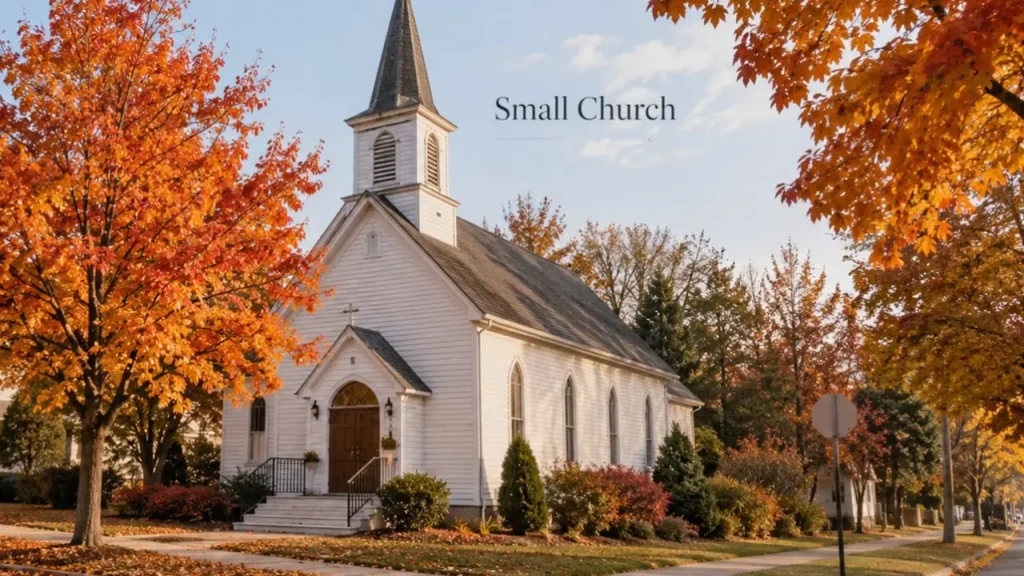
A few weeks ago, Edward Clayton wrote an article about small churches in America. have been a part of small churches. I, too, have seen small churches struggle, and even close. It truly is sad.for the people of that congregation and the community.
So what can small churches do to remain alive and vital?
As stated, in Edward Clayton’s article, we must acknowledge that small churches cannot provide all of the services of the larger and mega churches
It is a fact, many churches feel that they are in competition with other churches especially in small communities. Though they most often won’t admit it, they keep a jealous eye on the other church’s parking lot, checking the number of cars and if there are any new or different cars. New programs are often attempted, not always with the desire to better reach their community, but in an attempt to outdo the other, or others One pastor admitted that he added new or special programs in the summer, or other times when most churches suspended programs because he wanted a “special out reach.” Another pastor I knew would not cooperate with any congregation unless it would specifically benefit his church.
Maybe these congregations might begin working together to deal with this competition. Maybe we should begin to think not in terms of my denomination or their denomination, their church and our church, but in terms of the church being part of the body and Jesus Christ being the head.
“(22) God has put all things under the authority of Christ and has made him head over all things for the benefit of the church. (23) And the church is his body; it is made full and complete by Christ, who fills all things everywhere with himself.” Ephesians 1:22- 23.
We must acknowledge that the head of the church is our Lord Jesus Christ. All the body parts, the different congregations and members of all congregations, have separate functions and when each functions as it should, the body does not stumble all over its self, but is able to accomplish many different and difficult tasks
Let us begin with the reading of John 17, beginning with verse 20.” I ask…for those who will believe in me through their word, (21) that they may all be one, just as you, Father, are in me, and 1 in you, that they also may be in us, so that the world may believe that you have sent me. (22) The glory that you have given me, I have given to them, that they may be one even as we are one, (23) I in them, and you and me, that they may become perfectly one, so that the world may know that you sent me and loved them, even as you loved me.”
This is Jesus’ prayer for his followers. Clearly, it was his desire that believers all be one,
united together under him. Jesus is the head, therefore, all churches, small and large, need to work together to serve and bring glory to Jesus who is the head of the church. The enemy is not another congregation. The enemy is Satan!
When one sinner repents and becomes a follower of Jesus does not all heaven rejoice? And, when one church does well will not all heaven rejoice? When all heaven rejoices should not every church also join in the rejoicing? The obvious answer must be, “YES|,” if that church is part of the body of Jesus Christ!
So three questions must be asked, first, can we work together in a way that demonstrates that we celebrate Jesus as the head of the church and not let Satan bring division between the followers of Jesus? Second, can the several different congregations/churches be, and function together as, a part of the body of Jesus Christ to fulfill the Great Commission given by Jesus as recorded in Matthew 28:18-20? Third| how do we do it?
“Jesus came and told his disciples, ‘I have been given all authority in heaven and on earth. Therefore, go and make disciples of all the nations, baptizing them in the name of the Father and the Son and the Holy Spirit. Teach these new disciples to obey all the commands I have given you. And be sure of this: I am with you always, even until the end of the age.'” Matthew 28; 18-20
So, how can this be obeyed and accomplished?
In smaller communities, we sometimes find pastors of congregations meeting together on a weekly or monthly basis. Too often such meetings are just times of fellowship, complaining about problems, and planning a community worship service that may happen once a year. Maybe these leaders should begin asking questions. What are the needs of our community that we could meet if lack of staff or money were no object? How can we work together and yet maintain our identity as a congregation belonging to a larger group or denomination? What must be done as we work together to provide the programming for the people of our community? What are the deadlines that must be met? Who will do what?
For instance, large churches have staff specialists who work with the young people of their community. Small churches cannot afford this. But maybe we can work together to bring our youth to a common location and find or develop leaders who will be able to focus on the needs of the youth. Such a leader might be one of the pastors, it might be several of the parents of youth. Leaders may be found from among teachers in the local schools. Working together, the costs can be shared between these smaller churches. They might be able to employ part-time or full-time leadership from outside of the community. If there is a Christian college or university in the area, discussions might be held with faculty if they identify one or two students that might be able to carry on that ministry’s need.
In my own case, I was employed by a church to spend weekends with their youth during
my senior year in college. My wife and I traveled about one hundred miles each way for this ministry. We would drive to that location Friday afternoon noon for an evening youth meeting, We also met with the youth after a Sunday evening worship service. The local church sat up a room in the church to serve as temporary sleeping quarters
In another situation, our church invited a university student to spend Sundays with us to direct music and work with our choir. The student was with us for Sunday only. The cost was to pay mileage plus a small stipend
Working with the other churches in our small community, we were able to bring a special event that reached the whole area. Great new relationships were developed among the many members of the different congregations who worked together on the different committees needed make the event a success. People that were mere acquaintances became great friends and encouragers in the faith. This was a blessing to our community that no one had counted on.
It is truly amazing what can be accomplished when the body of Jesus works together to “make disciples.” When we let Jesus be the head of the body, nothing is impossible! (Hum, that sounds a little like something Jesus may have said.)