
Día de Muertos. All Hallows’ Eve. Samhain. Halloween.
Many times, we call them the same thing and connect them together with October 31st. But they are not the same celebration. Their histories sit close together on the calendar and have crossed through centuries of changing cultures, beliefs, and traditions.
For Christians, especially those of us with children, October often brings the same question:
What are we supposed to do with Halloween?
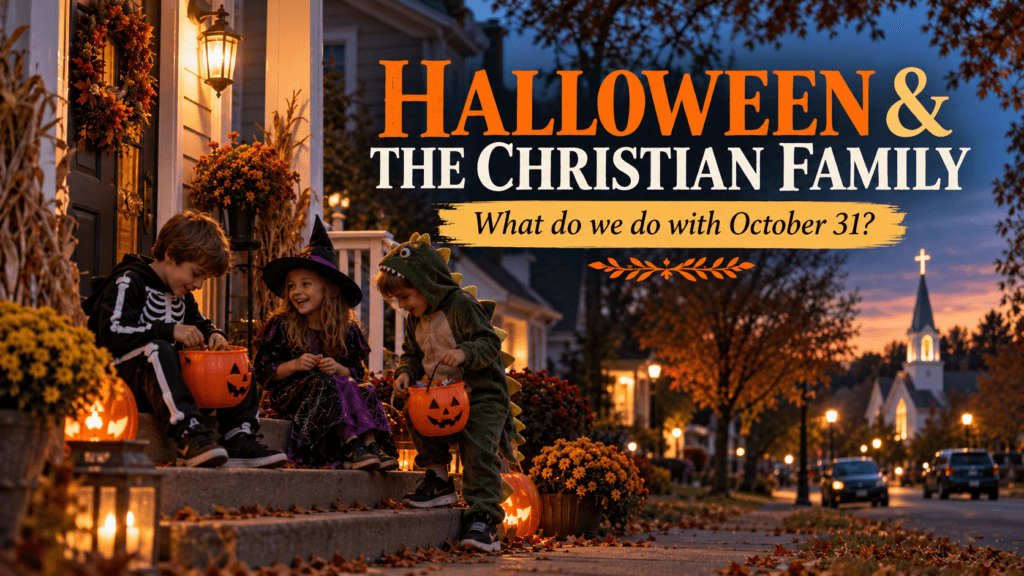
Some Christian families want nothing to do with it. Others attend fall festivals or church events instead. Some hand out candy but avoid costumes. Others let their children dress up, trick-or-treat, decorate the house, and enjoy Halloween much like their neighbors do.
But enjoying Halloween does not mean we should ignore where some of its traditions came from or pretend that everything associated with the holiday is spiritually harmless.
So before deciding what we should do with Halloween today, it helps to understand how we got here.
From Samhain to All Hallows’ Eve
One of Halloween’s oldest influences was Samhain, an ancient Gaelic festival marking the end of the harvest season and the beginning of winter.
Traditions surrounding Samhain developed around bonfires, the changing seasons, spirits, disguises, divination, and the belief that the boundary between this world and the Otherworld was particularly thin during this time.
Christianity eventually changed the calendar surrounding it.
By the Middle Ages, November 1 had become All Saints’ Day, or All Hallows’ Day, in the Western Church. The evening before it became All Hallows’ Eve, which eventually became the word Halloween.
November 2 became All Souls’ Day in Catholic tradition, associated with remembering and praying for the faithful who had died.
Older regional customs did not simply disappear. Christian observances and local traditions existed alongside one another and gradually became intertwined.
Halloween did not travel in a perfectly straight line from one ancient pagan ceremony into the bags of candy our children carry today. It has accumulated traditions from different cultures for centuries.
You will sometimes also see Roman festivals such as Feralia or traditions associated with Pomona connected to Halloween. Roman and Celtic cultures certainly interacted, but the historical connection is not clean enough to say Rome simply took over Samhain and renamed it like they did so many other things.
Día de Muertos, Day of the Dead, should also be treated separately rather than simply called another version of Halloween.
When the Spanish arrived in the Americas, Indigenous traditions of remembering deceased ancestors encountered Spanish Catholic observances of All Saints’ Day and All Souls’ Day.
Over time, those traditions blended into what developed as Día de Muertos in Mexico. That is why Halloween and Día de Muertos share parts of the calendar and some imagery surrounding death and remembrance while still being different traditions with different histories.
How Did We Get to Costumes and Candy?
Halloween came to America through European immigration, largely from the Irish and Scottish.
By the early 1900s, Halloween in America had also developed a reputation for pranks and vandalism. Not small pranks and jump scares, but real crimes. Communities tried to make the holiday a little more tame and organized by organizing costume contests and bribing with candy door to door.
Door-to-door customs were not completely new either. Turns out Americans once had traditions around Thanksgiving where costumed children went door to door asking for treats or money. I’m not much of a candy person, but I would walk door to door for some sweet potatoes.
Trick-or-treating began appearing in America before World War II, particularly during the 1920s and 1930s. The war slowed its spread because of sugar rationing.
After the war, it exploded. Sugar rationing ended, suburbs expanded with soldiers coming home and a postwar housing boom, the baby boom put more children in neighborhoods, and candy manufacturers had every reason to encourage a holiday centered around handing candy to children. This was much closer to what we know as Halloween now.
And if I ask my children what Halloween means, I doubt I am going to get a detailed explanation of Samhain or medieval cults. I am going to hear about costumes and candy.
Does the History Decide What Christians Can Do Today?
This is where Christians often disagree.
Some look at Halloween’s connections with paganism, death, witchcraft, and spiritualism and decide that their family should have nothing to do with it.
And that’s reasonable.
Others look at what Halloween has become in modern America and see something very different: children dressed as superheroes and princesses, bowls of candy, pumpkin carving, parties, and families walking around the neighborhood together.
I do not believe putting on a Spider-Man costume, carving a pumpkin, having friends over for a Halloween party, or walking your children around the neighborhood collecting Reese’s Cups is the same thing as participating in pagan worship. I think Christians can participate in those things with a clear conscience.
Origins matter, yes, but so does what something means and what we are actually doing with it today.
But There Is a Line
Saying that costumes and trick-or-treating can be innocent does not mean everything associated with Halloween should be treated as innocent.
Scripture is quite direct about divination, sorcery, attempts to communicate with the dead, and seeking supernatural knowledge or power apart from God.
Deuteronomy 18:9-14: “When you come into the land that the Lord your God is giving you, you shall not learn to follow the abominable practices of those nations. There shall not be found among you anyone who burns his son or his daughter as an offering, anyone who practices divination or tells fortunes or interprets omens, or sorcerer or a charmer or medium or a necromancer or cone who inquires of the dead, for whoever does these things is an abomination to the Lord. And because of these abominations the Lord your God is driving them out before you. You shall be blameless before the Lord your God, for these nations, which you are about to dispossess, listen to fortune-tellers and to diviners. But as for you, the Lord your God has not allowed you to do this.”
There are practices that get packaged as spooky entertainment but come directly from traditions of spiritualism, divination, or occult practice. While these can be found every day, Halloween is no exception.
A Ouija board, séances, attempts to summon or communicate with spirits, divination with tarot cards, pendulums or similar tools, scrying, spellcasting, and fortune-telling practices intended to seek answers from the supernatural.
Don’t be frightened by every Disney movie or kids’ costume. But don’t be so casual that we stop recognizing genuine occult practices when they are placed in front of us as entertainment.
There is room between fear and foolishness
So What About Halloween?
We dress up. We enjoy the decorations. My children trick-or-treat. We can have a Halloween party and enjoy ourselves without believing that we are worshiping anything other than God.
You may choose differently, and that’s okay.
Romans 14: I am convinced, being fully persuaded in the Lord Jesus, that nothing is unclean in itself. But if anyone regards something as unclean, then for that person it is unclean.
Christian liberty does not give us permission to engage in practices Scripture directly warns against.
So, dress up, enjoy being around friends and family, tell a story around a fire, and I’ll see you this October 31st.